MinIO, Wasabi and other S3-compatible storage
Point DBTrail's archives and baselines at a store that speaks the S3 API but is not AWS, with uploads and reads aimed at the same place.
MinIO, Wasabi, Ceph, Garage, LocalStack: one variable, and both uploads and DuckDB reads follow it.
BINTRAIL_S3_ENDPOINT=https://minio.internal:9000
AWS_ACCESS_KEY_ID=<your key>
AWS_SECRET_ACCESS_KEY=<your secret>
Credentials come from the normal AWS chain (environment, ~/.aws/credentials,
instance role). Covers --archive-s3, --baseline-s3, the archive reads behind
query and recover, and the daemon's uploads.
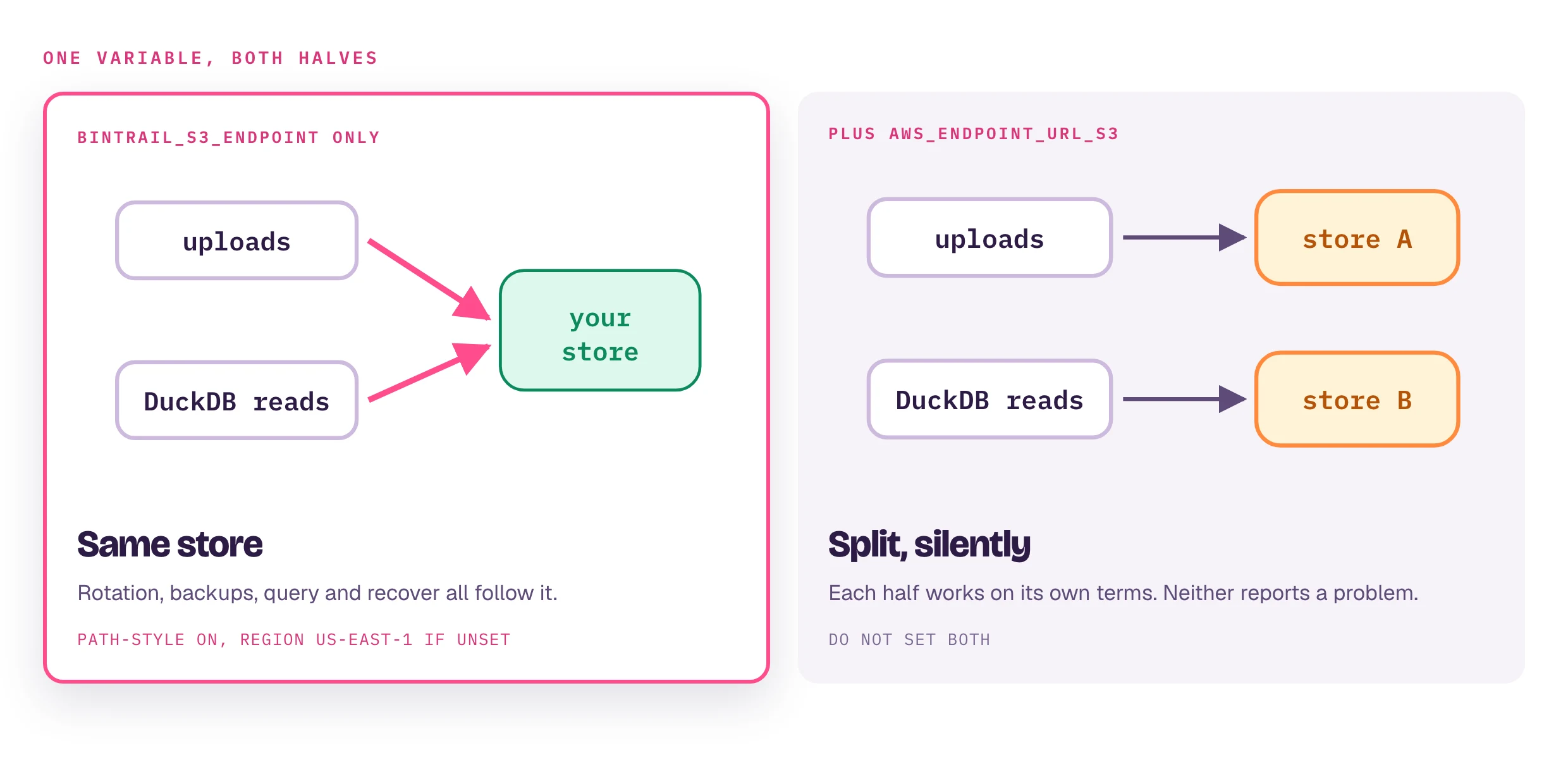
Why not the AWS variable
BINTRAIL_S3_ENDPOINT | AWS_ENDPOINT_URL_S3 | |
|---|---|---|
| Validated at startup | Yes, a bad value fails the load | No |
| Path-style addressing | On | SDK default, virtual-hosted |
| Region fallback | us-east-1 | Untouched |
MinIO and LocalStack need host/bucket. A virtual-hosted URL against them fails
at DNS resolution, which looks like a network outage.
Addressing style
BINTRAIL_S3_PATH_STYLE=0 # store wants bucket.hostWorks without BINTRAIL_S3_ENDPOINT too; it is the only lever when the endpoint
lives in ~/.aws/config.
Region
No region anywhere: us-east-1. MinIO accepts anything. A store with real
regions (Wasabi) needs endpoint and region to match. The region is pinned into
the DuckDB secret, so a mismatch fails at query time, not at upload.
BINTRAIL_S3_ENDPOINT=https://s3.eu-central-1.wasabisys.com
AWS_REGION=eu-central-1
In a compose file
services:
  dbtrail-console:
    image: ghcr.io/dbtrail/bintrail-console
    environment:
      BINTRAIL_S3_ENDPOINT: https://minio.internal:9000
      AWS_ACCESS_KEY_ID: ${MINIO_KEY}
AWS_SECRET_ACCESS_KEY: ${MINIO_SECRET}| Where | Scope | |
|---|---|---|
| Which bucket | Archive to S3 in the server form | Per server |
| Which store | BINTRAIL_S3_ENDPOINT | Whole daemon |
Two servers can use two buckets, in the same store. Two stores means two daemons; per-server endpoints are issue #1575.
Checking it works
Upload, then read back: bintrail status lists archives and coverage;
bintrail archive reconcile scans the bucket against the index, the same read
path a recovery uses. A wrong endpoint usually shows as an empty listing, not
an error.
views.sql for DuckDB
The generated views.sql (Query in DuckDB) carries
endpoint, addressing style and region, never keys: it uses
PROVIDER credential_chain, so whoever opens it brings their own credentials.