
Limitations
What DBTrail does not capture, cannot undo, or refuses to rebuild. Read this before you rely on it.
By design means intended; not yet means a known gap. DBTrail refuses out loud, with an error, a warning or a status word. A silent partial result is a bug: report it.
The analytical replica
- Not high availability. Your app never points at the copy, and nothing fails over to it.
- Not your backup. History starts the day you install it. Keep your own backups.
- Behind by your schedule. Off until you turn it on, then once a day unless you choose more often. Minutes at best, never seconds.
- Not a MySQL server. A MySQL client can connect, but the SQL is DuckDB's: Query Parquet with MySQL.
- Read it through
views.sql. Another tool reading the files directly can miss recent changes, with no error. For Spark, Trino or Athena: Export to Iceberg. - Row history needs an S3 bucket. Without one it is kept 48 hours. The copy itself stays. Retention.
SQL on the copy
The SQL card and a MySQL client run
your statement in DuckDB. Most text and number answers match MySQL's:
'Paid' equals 'paid', 'café' equals 'cafe', 'ß' equals 'ss', a
_bin column compares byte by byte, ROUND(SUM(amount), 2) prints
117329550.00, and NULLs sort where MySQL puts them. These still differ, with
no error (by design):
| Same statement | MySQL | The copy |
|---|---|---|
AVG(amount) on a DECIMAL(12,2) | 1.800000 | 1.8 |
qty / 3 | 1.3333 | 1.3333333333333333 |
'Paid' LIKE 'paid' | true | false |
count(DISTINCT status) over paid, Paid | 1 | 2 |
'a' = 'A' on a _cs column | false | true |
'bob ' = 'bob' on a utf8mb4_general_ci column | true | false |
ORDER BY an ENUM('z','a') column | z, a | a, z |
SELECT * on a table with a generated column | has it | one column fewer |
REGEXP, instr and the duplicate removal of UNION see case too. On a
MariaDB source the trailing-space row applies to every text column not
declared nopad. Fine for a report a person reads; a program that compares
the text it gets back can break.
The full list.
Sources
| Source | Status |
|---|---|
| MySQL 8.0, 8.4, Percona Server (RDS and Aurora; Cloud SQL should work) | Supported |
| PostgreSQL 14+ | Beta: limitations |
| MariaDB 10.11+ | Supported: what is untested |
The index, where DBTrail keeps the changes, is always MySQL 8.0+ (by design).
What capture does not see
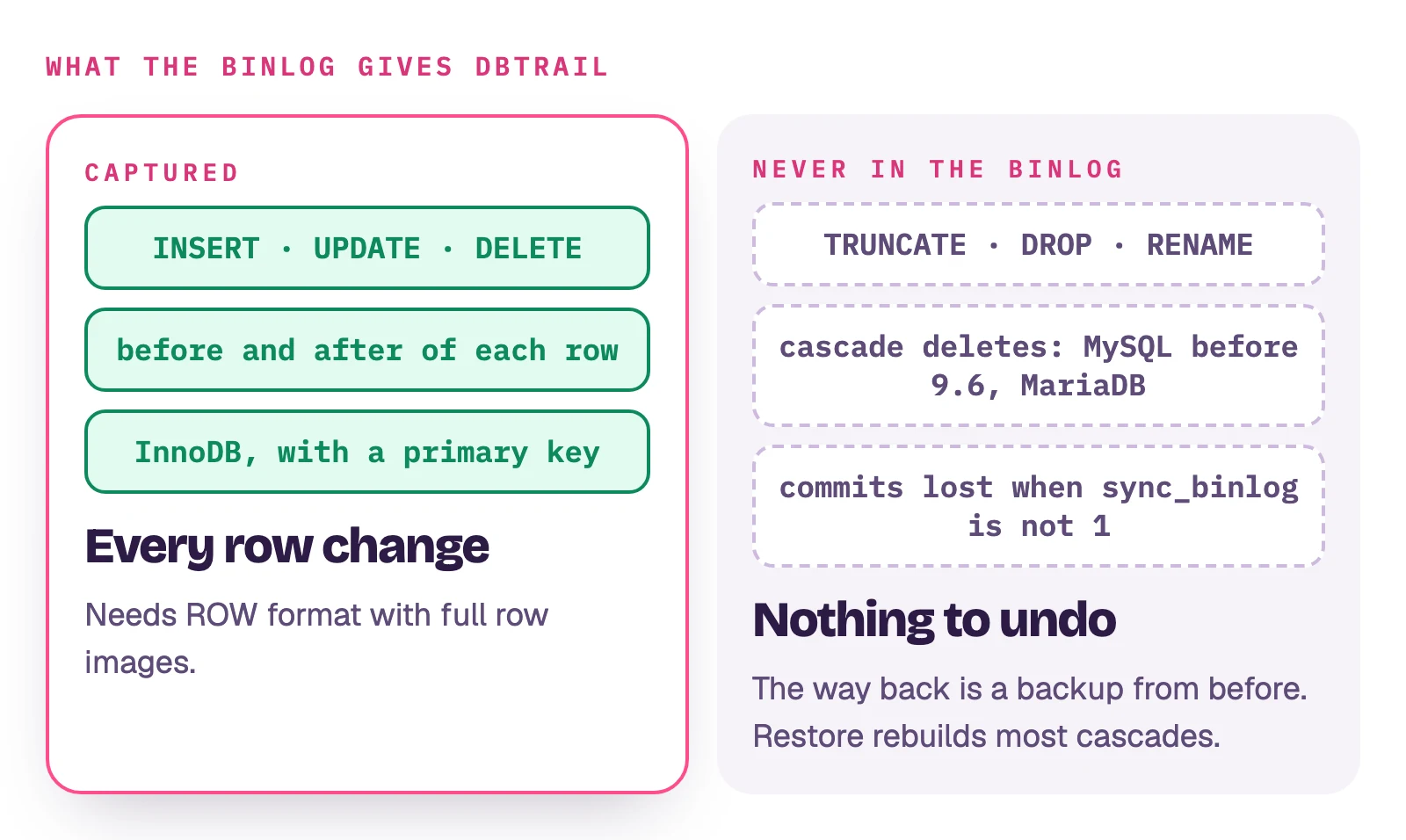
- The binlog must be ROW with full row images (by design). Otherwise capture does not start.
- Tables without a primary key, or not InnoDB, are skipped (by design). Find them.
TRUNCATE,DROP,RENAME,CREATE OR REPLACE TABLEleave no rows in the binlog (by design, MySQL). Investigate → Schema changes lists them; the way back is a backup from before.- Rows deleted by a cascade (MySQL before 9.6, and MariaDB) are not in the binlog. Restore rebuilds most of them. Details.
- JSON updates with
binlog_row_value_options=PARTIAL_JSONare skipped (not yet). Fix:SET PERSIST binlog_row_value_options = ''; - Tagged GTIDs (MySQL 8.3+,
SET gtid_next = 'AUTOMATIC:<tag>') are not tracked (not yet). After a reconnect or restart their rows can be saved twice, and a purged binlog that held them shows as lost data. Only sources that set a tag on purpose are affected; capture those in position mode. Details. sync_binlogother than 1: an operating-system crash can lose commits before they reach the binlog (by design, MySQL).- After a schema change, DBTrail reads the new schema before the next row. If it cannot, capture stops and retries; nothing is skipped.
Undo
- DBTrail never runs the undo (by design). You review the script and run it.
- Triggers fire again when you run it (by design, MySQL).
AUTO_INCREMENTis not reset. The script says so.- Caps: 1,000 changes per undo script by default, 10,000 at most.
Rebuilding a table at a moment
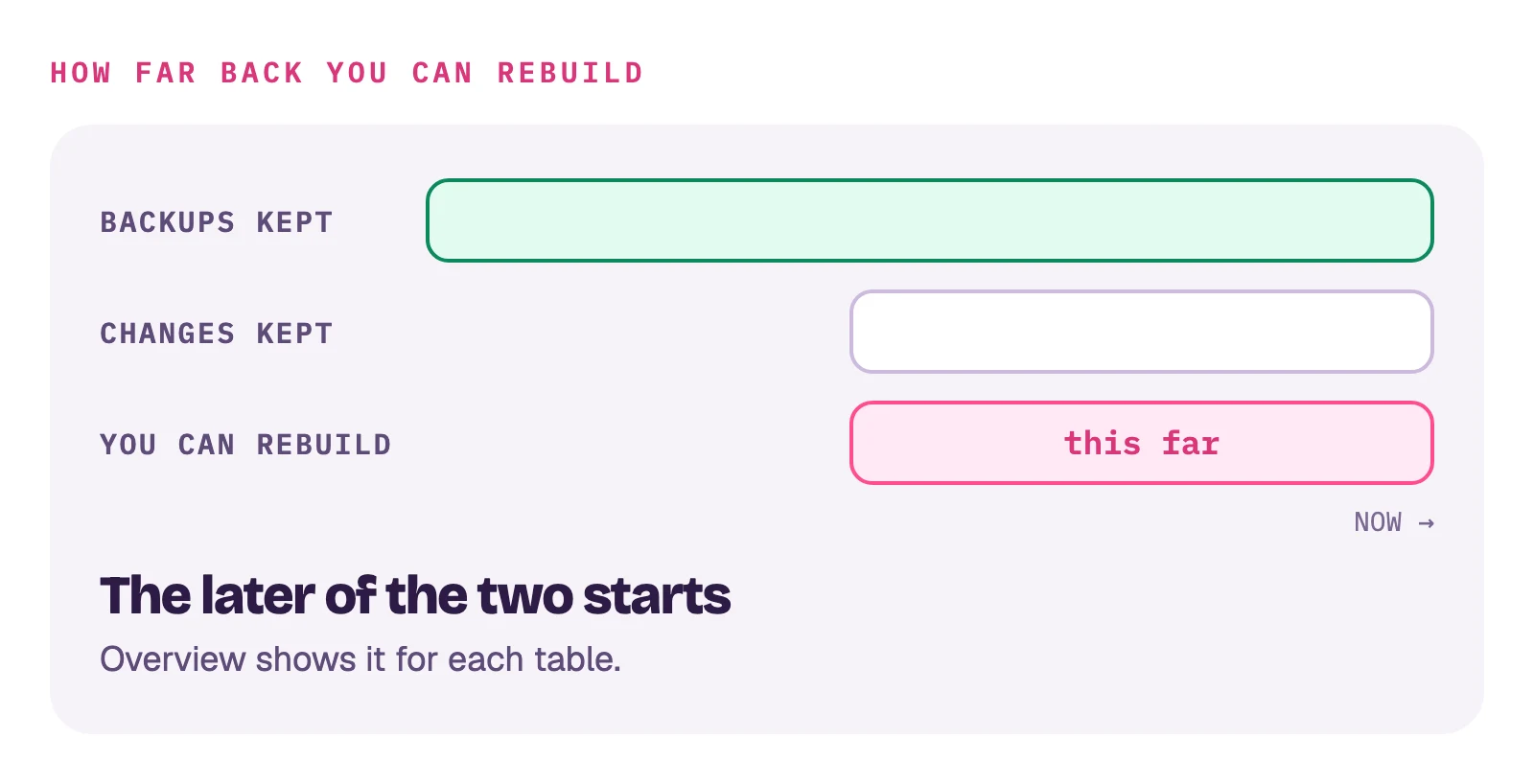
- Needs a snapshot from before that moment. Without one, a full-table rebuild is refused, never partial.
- Refused: a primary key of type
FLOAT,DOUBLE,TIME,BIT,JSON, spatial or generated; a key value that changed in the window; a column added, dropped or retyped after the snapshot. - Can be refused for lack of disk or memory.
- One-second resolution (not yet). A full-table rebuild can apply half of a transaction that straddles the requested second.
- Time-travel SQL port (beta): its limitations.
Verification
A MATCH is a strong signal, not a certificate.
What a MATCH proves.
Running it
- You operate the index MySQL (by design): disk, backups, upgrades. Support scope.
- A snapshot is read by the DBTrail that wrote it, or a newer one. Copy the small change files together with each table file.
- DBTrail only reads your database. It installs nothing in it and never
runs a script it generated. One exception you turn on yourself:
read routing
passes a client's writes to your MySQL, unless
--route-read-only. - The web interface listens only on this machine in the bundled stack. To open it up: Web interface on a hostname.
- The time-travel port has no TLS. Keep it on this machine, or put ProxySQL in front.
- Claude only reads. It cannot point DBTrail at another database.
Missing a limit, or blocked by a "not yet"? Open an issue.